Power & Cooling

Power and cooling form the core of datacenter reliability, working together to protect mission‑critical workloads from electrical instability and thermal stress. InfraClusters designs these systems as an integrated architecture — delivering clean, redundant power and precision environmental control that scales seamlessly from traditional enterprise racks to high‑density GPU clusters.

Datacenter Power

Reliable, redundant power is the foundation of every high‑performance datacenter. InfraClusters designs its power architecture to deliver clean, conditioned, and uninterrupted energy from the utility feed all the way to the rack, ensuring mission‑critical workloads remain stable under any operating condition.

Power Architecture

Reliable power is the foundation of every datacenter. Our approach ensures continuous availability, clean power delivery, and fault‑tolerant design across all layers of the electrical system.

Power redudancy

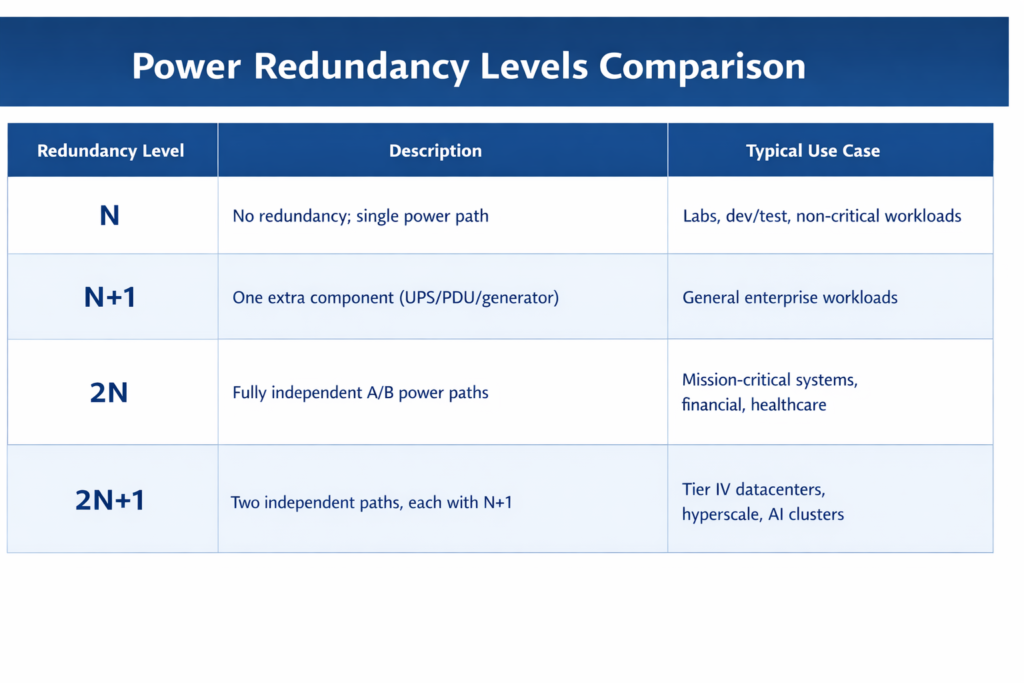
Redundant UPS topologies (N, N+1, 2N, 2N+1) engineered for uptime and predictable failover

Power Efficiency

High‑efficiency power distribution using PDUs, RPPs, and intelligent metering

Power Capacity

Load balancing and capacity planning for high‑density racks, GPU clusters, and HPC workloads

Power Backups

Generator and ATS integration for seamless transition during utility events

Power Quality

Power quality and harmonics management to protect sensitive compute and storage systems

Power Uptime

Scalable designs that support phased growth without operational disruption

Power Structure

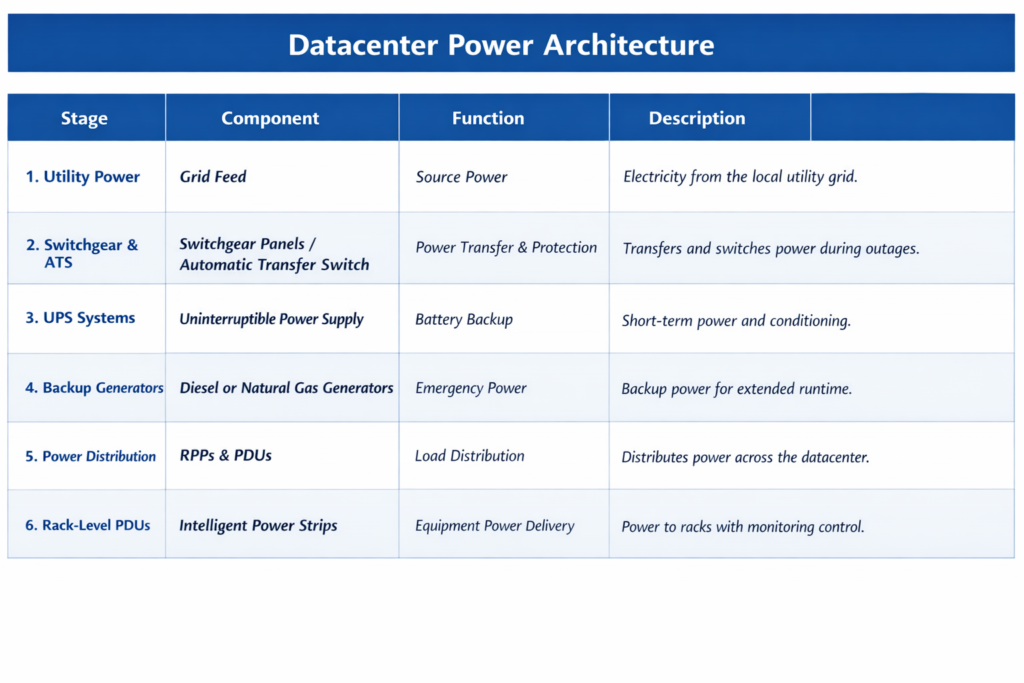
InfraClusters datacenters follow a layered power architecture designed for reliability and efficiency. Electricity flows seamlessly from the utility grid through switchgear, UPS systems, and backup generators before reaching intelligent rack‑level PDUs. Each stage ensures clean, conditioned power delivery, protecting critical workloads and maintaining uptime across every environment.

UPS Systems & Components

Uninterruptible Power Supply (UPS) systems form the critical bridge between utility power and backup generation. They provide instantaneous protection against voltage fluctuations, surges, and short‑term outages, ensuring continuous operation for sensitive equipment.

Rectifier

The rectifier converts incoming AC power from the utility or generator into DC power. This DC power charges the battery system and feeds the inverter. Its primary role is to stabilize and condition the incoming electrical supply, removing noise, spikes, and voltage fluctuations before it reaches critical equipment.

Battery System

The battery bank stores DC energy and provides immediate backup power when utility power drops or fluctuates. Batteries supply several minutes of runtime, bridging the gap between an outage and generator startup. Their health, temperature, and charge cycles are continuously monitored to ensure predictable performance.

Inverter

The inverter converts DC power from the rectifier or battery system back into clean, stable AC power for the datacenter load. It ensures that servers and network equipment receive consistent voltage and frequency, even during transitions between power sources.

Static Bypass Switch

The static bypass provides an alternate path for power to flow directly to the load if the UPS experiences a fault or requires maintenance. This switch transfers power in milliseconds, ensuring uninterrupted operation while isolating the UPS for service or failure conditions.

Maintenance Bypass

A manual bypass panel allows technicians to safely remove the UPS from service for planned maintenance without impacting the load. It provides a controlled, human‑operated path around the UPS, ensuring operational continuity during scheduled work.

Monitoring & Control Interface

Modern UPS systems include integrated monitoring for load levels, battery health, temperature, efficiency, and event logs. These interfaces connect to DCIM platforms, enabling real‑time visibility, predictive alerts, and automated reporting for capacity planning and risk mitigation.

Power Redundancy levels

Power redundancy defines how resilient a datacenter’s electrical system is against failure. Each level — from N to 2N+1 — represents increasing reliability, with N offering a single power path and 2N+1 providing dual independent feeds plus component redundancy. These configurations ensure continuous uptime, allowing critical workloads to remain operational even during maintenance or unexpected outages.

Datacenter Cooling

Efficient cooling is essential to maintaining performance and reliability in high‑density datacenter environments. InfraClusters integrates precision cooling systems engineered to manage thermal loads from traditional enterprise racks to GPU‑intensive compute clusters. Each design balances airflow, temperature, and humidity to ensure optimal equipment longevity and energy efficiency.

Cooling Architecture

InfraClusters cooling follows a layered approach that mirrors the power structure — delivering stability from facility level down to the rack. This design ensures that thermal management scales seamlessly with workload density, maintaining consistent performance even as compute demands grow. Below are the key features.

CRAC/CRAH Units

Computer Room Air Conditioners and Air Handlers regulate temperature and humidity across the datacenter floor.

Chilled Water Systems

Centralized chillers and pumps circulate cooled water through coils and heat exchangers for consistent thermal control.

In‑Row Cooling

Precision units placed between racks capture and cool hot air directly at the source, improving efficiency for high‑density zones.

Rear‑Door Heat Exchangers

Mounted on rack doors, these systems remove heat before it enters the room, ideal for GPU and AI deployments.

Liquid Cooling Loops

Direct‑to‑chip or immersion cooling solutions handle extreme workloads exceeding 60 kW per rack.

Airflow Management

Hot‑aisle/cold‑aisle containment ensures separation of intake and exhaust air, maximizing cooling effectiveness.

Environmental Monitoring

Continuous telemetry ensures cooling systems respond dynamically to load changes:

  • Temperature and humidity sensors across aisles and racks
  • Pressure and flow monitoring for chilled water systems
  • Automated alerts for thermal thresholds
  • Integration with DCIM platforms for predictive analytics

This proactive monitoring prevents hotspots and optimizes energy use across the facility.

Efficiency & Sustainability

InfraClusters cooling designs prioritize sustainability through:

  • Variable‑speed fans and pumps
  • Economizer modes for free cooling during favorable conditions
  • High‑efficiency chillers and refrigerants
  • Real‑time PUE tracking and optimization

These measures reduce operational costs while supporting environmental responsibility.

CRAC and CRAH Systems

Computer Room Air Conditioners (CRAC) and Computer Room Air Handlers (CRAH) are the backbone of datacenter environmental control. Both systems maintain stable temperature and humidity levels, ensuring reliable operation of IT equipment. While they serve the same purpose, their cooling mechanisms differ — one uses direct expansion (DX) refrigerant cooling, and the other relies on chilled water supplied from a central plant.

Computer Room Air Conditioners (CRAC)

Computer Room Air Conditioners (CRAC) provide precise, self‑contained cooling for datacenter environments using direct expansion technology. They deliver stable temperature and humidity control across critical IT spaces, making them a reliable solution for smaller facilities, edge deployments, and zones without chilled‑water infrastructure.

Direct Expansion (DX) Cooling

Uses refrigerant‑based heat exchange with an internal compressor, evaporator, and condenser to cool air directly within the unit.

Precision Temperature Control

Maintains tight temperature tolerances across the datacenter floor, ensuring consistent conditions for sensitive IT equipment.

Integrated Humidification

Includes built‑in humidifiers or dehumidifiers to regulate moisture levels and prevent static discharge or condensation

Self-Contained Design

Operates independently without requiring a chilled‑water plant, making it ideal for smaller or isolated environments.

Variable Speed Fans

Adjust airflow dynamically based on load and temperature, improving energy efficiency and reducing noise.

Monitoring & Alarm Integration

Connects to Building Management Systems (BMS) for real‑time monitoring of temperature, humidity, and system performance, with automated alerts for deviations.

Computer Room Air Handlers (CRAH)

Computer Room Air Handlers (CRAH) deliver high‑efficiency cooling using chilled water supplied from a central plant, making them ideal for modern, large‑scale datacenter environments. By leveraging chilled‑water coils and variable‑speed airflow control, CRAH units provide scalable, energy‑efficient thermal management for high‑density compute and multi‑tenant facilities.

Chilled‑Water Cooling Efficiency

Uses chilled‑water coils instead of refrigerant, delivering higher efficiency and lower operating costs in large‑scale environments.

Modulating Control Valves

Adjusts chilled‑water flow in real time based on thermal demand, ensuring precise temperature regulation and optimized energy use.

Variable Speed Fans

Dynamically modulate airflow to match load conditions, improving efficiency and reducing unnecessary power consumption

Low Mechanical Complexity

With no internal compressor, CRAH units have fewer moving parts, resulting in reduced maintenance requirements and improved long‑term reliability.

Central Plant Integration

Seamlessly connects to facility‑level chillers, pumps, and heat‑rejection systems, enabling scalable cooling for high‑density and multi‑tenant datacenters.

Advanced Monitoring & BMS Connectivity

Provides real‑time visibility into temperature, humidity, water flow, and coil performance through Building Management System integration.

Operational Integration

In advanced facilities, CRAC and CRAH units often coexist — CRACs handle smaller zones or edge deployments, while CRAHs manage large, chilled‑water environments. Both systems integrate with Building Management Systems (BMS) for real‑time monitoring of supply and return temperatures, humidity, and airflow. This coordination ensures balanced cooling and optimal energy use across the datacenter.